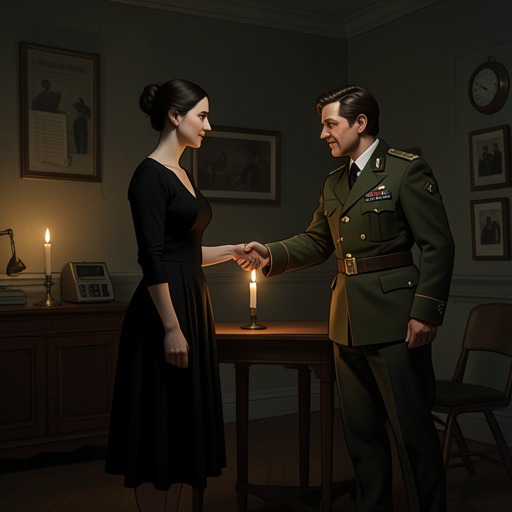
Alice Ruthven–Martin Ruthven marriage
Young Captain Jack · The Son of a SoldierThe Alice Ruthven–Martin Ruthven marriage is the absent but governing relationship at the center of the Ruthven household. Its decisive significance lies in what remains after Martin Ruthven’s death: Alice Ruthven must sustain the family, the plantation, and the emotional world shared by Marion Ruthven and Jack Ruthven while the American Civil War turns property, parentage, and domestic security into matters of life and death.
Marriage and Household
Alice Ruthven was married to Colonel Martin Ruthven, whose household occupied a large mansion set back from the river on one of the richest plantations in South Carolina. Their marriage therefore joined domestic authority to substantial landholding and placed the family within the material hierarchy of the wartime South. The evidence presents the household not merely as a private residence but as the social and economic center from which the children’s lives, the plantation’s future, and the family’s claims to property are understood.
The marriage also established Alice Ruthven as the mother of Marion Ruthven. Marion, seventeen and described as beautiful, was deeply attached to Jack Ruthven, whom Alice and Martin had adopted when he was a small child. Jack was not their biological son, but the household treated him as Marion’s brother and as one of the children of the family. Alice’s marriage to Martin thus helped create a family structure in which legal and emotional belonging mattered alongside blood descent.
Martin Ruthven’s Death and Alice’s Widowhood
Martin Ruthven was killed at the bloody Battle of Gettysburg. His sudden death shocked Alice Ruthven and the children so severely that Alice remained ill in bed for a long period. When she later became able to move about again, she was still weak and pale, and her children were described as her single consolation. Her widowhood is consequently portrayed not as a simple change in marital status but as a physical and emotional condition produced by wartime loss.
Martin’s death removed the household’s patriarch at a moment when military danger and economic pressure were intensifying. Alice had to protect Marion and Jack without the husband whose position as Colonel Ruthven had represented both family authority and wartime standing. Her attachment to the children became more concentrated after the bereavement. Jack’s repeated wish to enlist as a drummer boy was rejected by Alice, whose refusal reflects the protective responsibility imposed on her by Martin’s death and by the earlier loss that had already weakened the household.
Family, Property, and Conflict
The marriage’s consequences continue through the household’s treatment of Jack. Although St. John Ruthven tries to undermine Jack by claiming that he is a nobody who does not belong to the Ruthven family, Marion explains that Alice and Martin adopted him when he was three or four years old and made him John Ruthven, her brother. The accusation is therefore not only an insult to Jack’s identity; it threatens the family arrangement created during Alice and Martin’s marriage.
Property makes that threat concrete. Alice later intends to leave Jack half of the property, a decision that astonishes St. John Ruthven because it frustrates his plan to marry Marion and combine the two plantations for their mutual financial advantage. The marriage between Alice and Martin has therefore generated an inheritance structure in which affection, adoption, and property are connected. Alice’s intention recognizes Jack as a member of the household in practical as well as emotional terms, while St. John’s proposed marriage treats Marion and the plantation as instruments of economic rescue.
The family’s past is also tied to a damaged wedding ring and to documents recovered from the Nautilus wreck. A small jewel casket contains the ring and a delicate lace handkerchief, while the later papers include a marriage certificate and letters concerning property. These objects belong to a wider chain of marital and inheritance evidence: marriage is represented not only through memory and mourning but through material records that can establish relationships and determine who may claim a fortune.
War and the Survival of the Home
After Martin’s death, Alice’s household becomes exposed to the disorder of war. Cavalry passes the Ruthven homestead, followed by guerrillas described as looters who fight for the sake of plunder. Jack organizes a command across the lawn to defend the house. The scene makes visible the vulnerability of the home that Martin and Alice had shared: once the husband and military protector is gone, the plantation must be defended by the younger members of the family against forces that disregard private property.
Alice’s return to the house after danger has passed is marked by an embrace of Marion and Jack and by relief that both have come back safely. Her gesture restores, however briefly, the domestic bond that war repeatedly threatens to break. The home’s survival depends less on the continued presence of its original patriarch than on Alice’s care, the children’s loyalty, and the family’s willingness to defend one another.
Aftermath and Lasting Significance
Martin Ruthven’s death remains a permanent absence, but it does not end the family structure he helped establish. Alice continues to regard Jack as her son and Marion as part of the same protective circle. When Colonel Stanton later proves that Jack is his biological son, Jack’s birth identity changes, yet his place in Alice’s household is not erased. The distinction between biological parentage and lived family belonging is especially important because Alice and Martin had already made Jack their child through adoption and daily care.
The consequences of the marriage ultimately extend into the postwar settlement. After the Civil War ends, Colonel Stanton considers returning North, but Alice Ruthven cannot bear to part with Jack, and the family decides to remain at the plantation. A year later, Colonel Stanton marries the widow, so Alice becomes Mrs. Stanton and once again becomes Jack’s mother within a formal marriage. This later union does not cancel her marriage to Martin Ruthven; rather, it follows the widowhood created by his death and carries forward the maternal household that Martin’s marriage had helped form.
In narrative terms, the Alice Ruthven–Martin Ruthven marriage is defined by absence, inheritance, and continuity. Martin’s death supplies the household’s central wound, while Alice’s endurance preserves its human meaning. The marriage begins as the foundation of a wealthy plantation family, is shattered by the Battle of Gettysburg, and survives indirectly through Alice’s protection of Marion and Jack, her recognition of Jack’s share in the property, and the family’s eventual reorganization after the war.